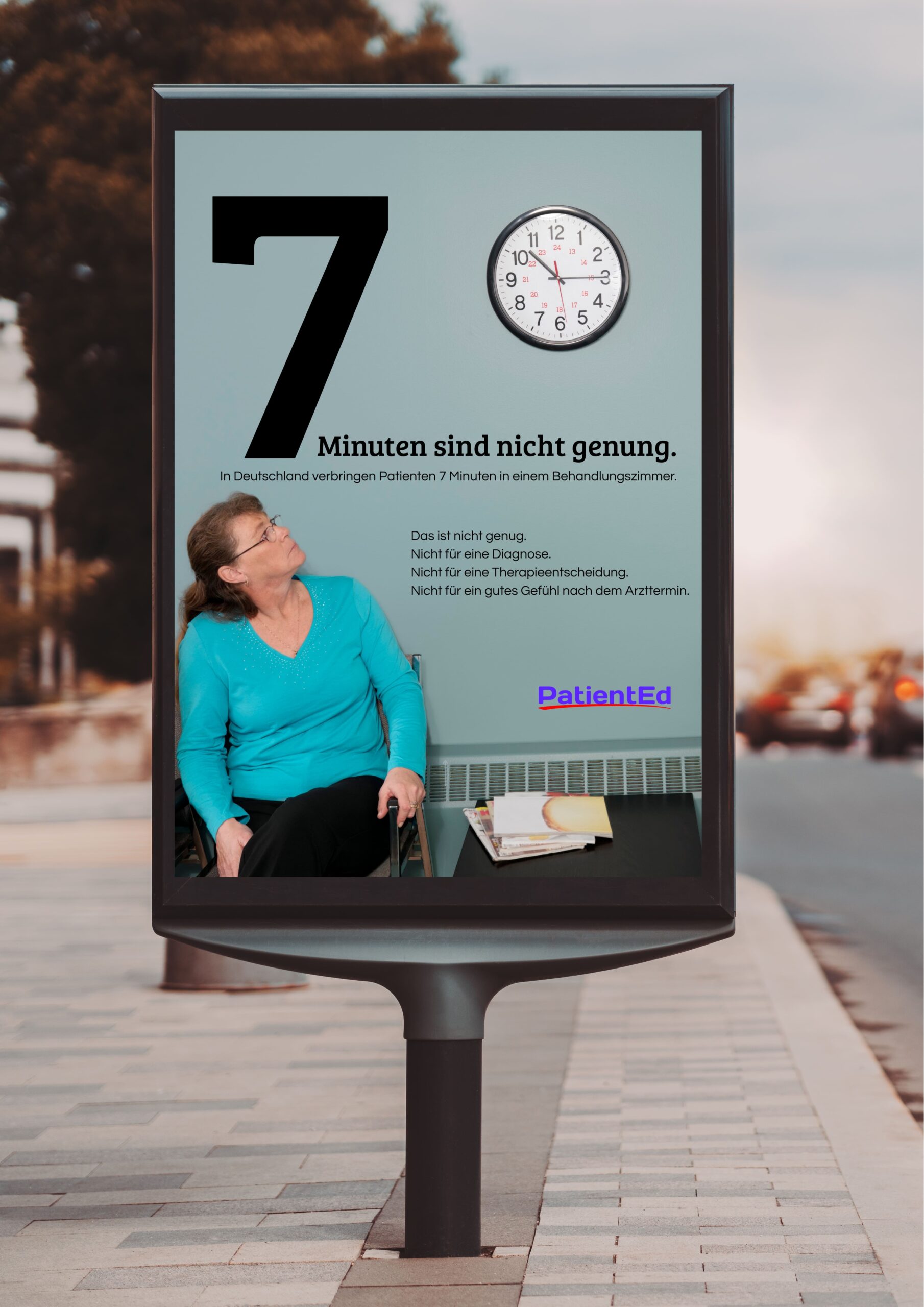
The weakness in the health system – with real consequences for millions of people.
You often wait weeks for a doctor's appointment.
Finally you sit in the treatment room – and the clock is running.
The door closes, the screen lights up, technical terms fall quickly.
You listen, nod, try to think along. Questions remain unspoken.
A little later you leave the doctor's office. Not with clarity, but with uncertainty. With more questions than answers. And with the feeling of not having fully understood something important.
This experience is not an isolated case. It is a structural problem.
7,6Minutes
This is how much time remains in Germany per doctor's contact.
5-10Minutes
This is the average consultation time in Europe – regardless of complexity or diagnosis.
Up to 50%
So many patients do not comply with therapies or medications correctly.
€125Billions
This is how high the costs incurred in Europe by non-adherence alone are estimated.
PatientEd creates added value
Good patient education is systemically relevant.
For patients
It enables informed decisions, security and real participation in one's own therapy.
For doctors
It relieves conversations, creates structure, reduces repetitions and strengthens the doctor-patient relationship.
For the health system
It prevents complications, increases adherence to therapy and reduces billions in costs through avoidable follow-up treatments.
PatientEd accompanies
PatientEd extends patient education.
PatientEd makes medical information understandable, repeatable and accessible at all times.
Before the appointment. After the appointment. Between appointments.
PatientEd does not replace medical communication. It makes it work.
PatientEd relieves
PatientEd strengthens the relationship between doctor and patient.
Easy integration
PatientEd is silently integrated and relieves medical personnel.
Culturally sensitive
PatientEd speaks the patient's language and thus breaks down language barriers.
Accessible at any time
PatientEd is ready to take care of patients' requests at any time.
Tool with impact
PatientEd improves medical performance noticeably and with verifiable key figures.
Good medicine doesn't end with the appointment.
It begins where understanding arises.